Give your eyes a route
A busy picture is easier to describe when you decide where to look next. Use the same route each time: the whole scene, the foreground from left to right, then the background. Finish with one overall impression.
Scene → front left → centre / right → background → overall
- Set the scene in one sentence. Name the place and the main activity: “This picture shows a neighbourhood park where several people are spending time outdoors.” Give the listener a setting before you zoom in.
- Move across the foreground, from left to right. Choose two or three groups. For each one, say where they are, who you see, and what they are doing. Add one visible detail, such as a jacket colour or an object they are holding. Finish that group before moving on.
- Move back once. Use “Behind them…” or “In the background…” to describe another activity and a detail of the setting. You can leave out small objects; the listener needs a clear picture, not an inventory.
- Close with the overall impression. One short sentence is enough: “Overall, it looks like a relaxed afternoon in the park.” Base the impression on what you can see. There is no need to invent a story or predict what happens next.
Use the preparation time to choose, not script
In your 30 seconds, identify the setting, choose three or four activities, and put them in order. Note a few anchors, such as “park / stroller / bicycle / picnic / ball”. Keep your notes short enough to glance at while speaking. You are choosing a route, not writing a paragraph to read.
For each stop: where → who → action
“On the left, a woman in a yellow jacket is pushing a stroller.” That sentence places the person, identifies her, and describes an action. Add one relevant detail, then move to the next group. Use present continuous for actions: “is carrying”, “are talking”, “is waiting”.
- If you lose your place
- Look at the next group on your route and say “Next to them…” or “Further back…”. You do not need to restart.
- If you cannot remember a word
- Describe its purpose: “a small seat on wheels for a baby”. Keep going with words you know.
- If a detail is uncertain
- Use “appears to be” for a reasonable interpretation. Describe what is visible; avoid inventing names, relationships, or reasons people are there. Save predictions for Task 4.
Three scenes to practise
Choose a picture. Take 30 seconds to plan, then describe it aloud for 60 seconds before reading the sample. All three pictures are open; the first sample answer is open and the other two are included with Pro.
Task example
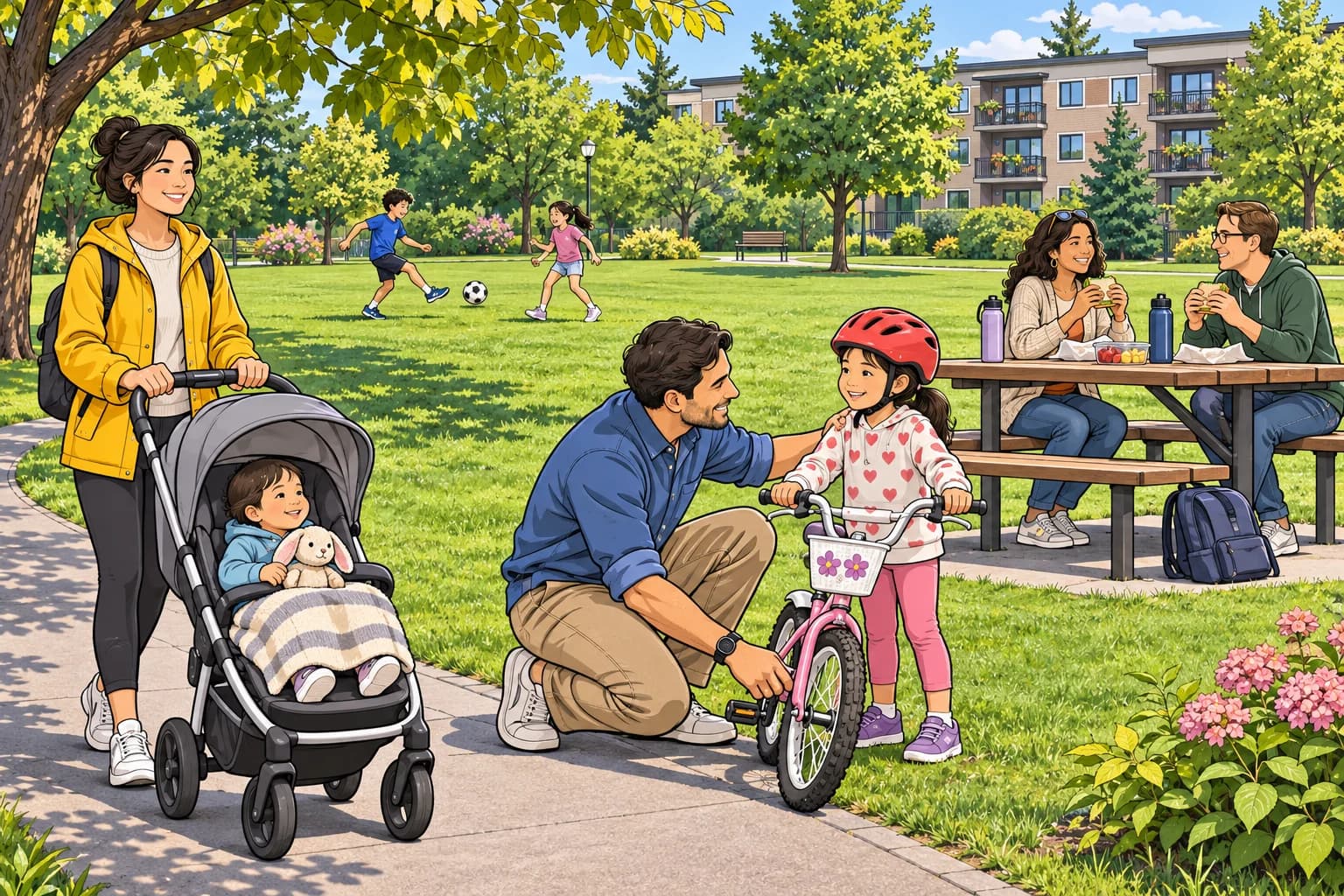
Describe what is happening in this park to someone who cannot see the picture.
Sample answer
SceneThis picture shows a neighbourhood park on a sunny day, with several groups enjoying the outdoor space.
Front leftOn the left, a woman in a yellow jacket is pushing a stroller along the path. She is passing a grassy area beside the trees.
Centre / rightIn the centre, a man in a blue shirt is kneeling beside a little girl with a bicycle. She is wearing a red helmet, and he appears to be helping her. Further to the right, two people are sitting at a picnic table with some food in front of them.
BackgroundBehind these groups, two children are playing with a ball on the grass. There are trees and an apartment building in the distance.
OverallOverall, the park looks relaxed, with people enjoying several different activities.
The labels show the route through the picture; do not read them aloud. Time your own delivery and shorten a detail if needed.
Task example

Describe what is happening at this outdoor market to someone who cannot see the picture.
Sample answer
This annotated sample answer is included with Pro. You can still use the picture above to practise your own description.
Create accountTask example
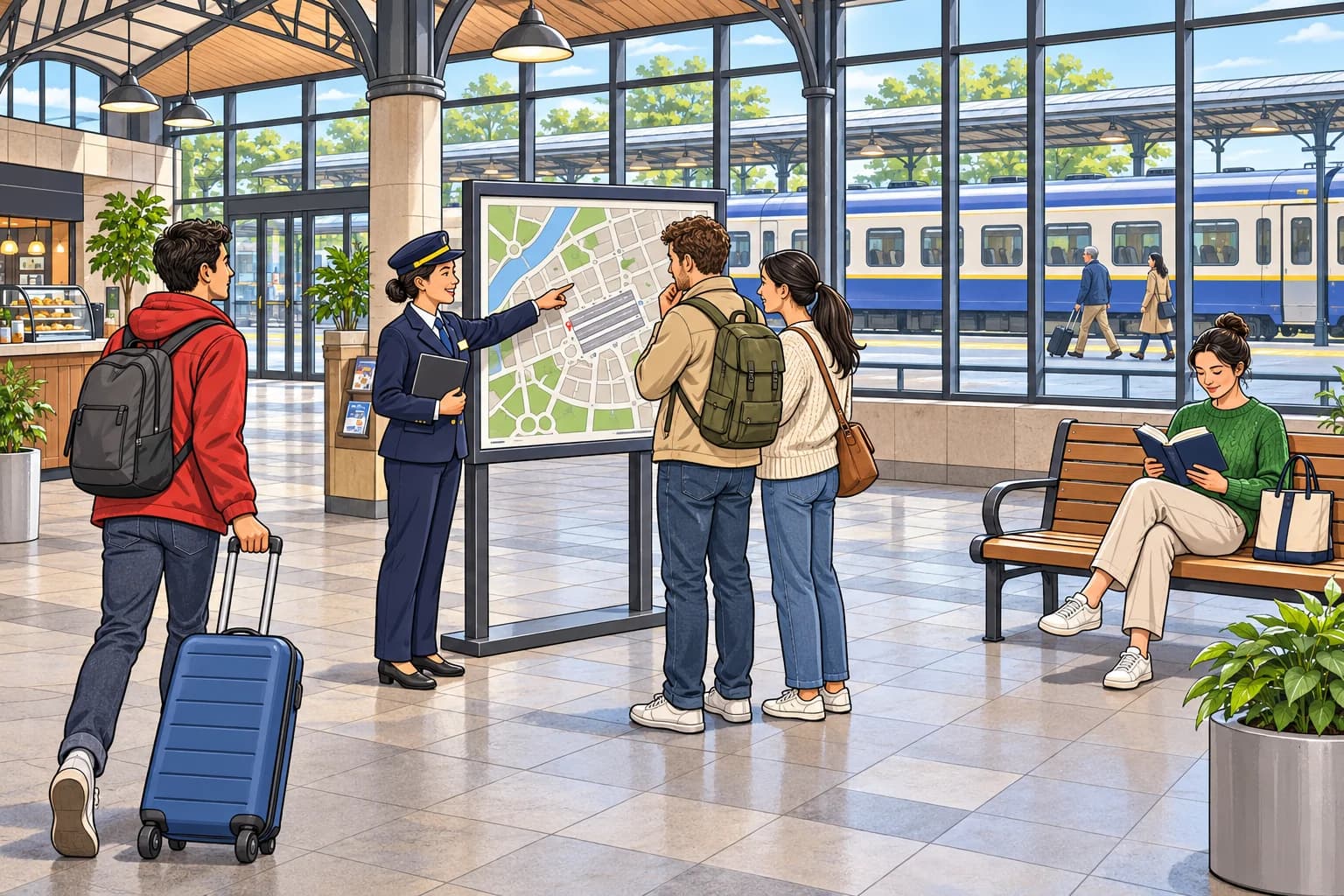
Describe what is happening in this railway station to someone who cannot see the picture.
Sample answer
This annotated sample answer is included with Pro. You can still use the picture above to practise your own description.
Create accountTask format and timing: official CELPIP Speaking Pro study pack (Task 3).